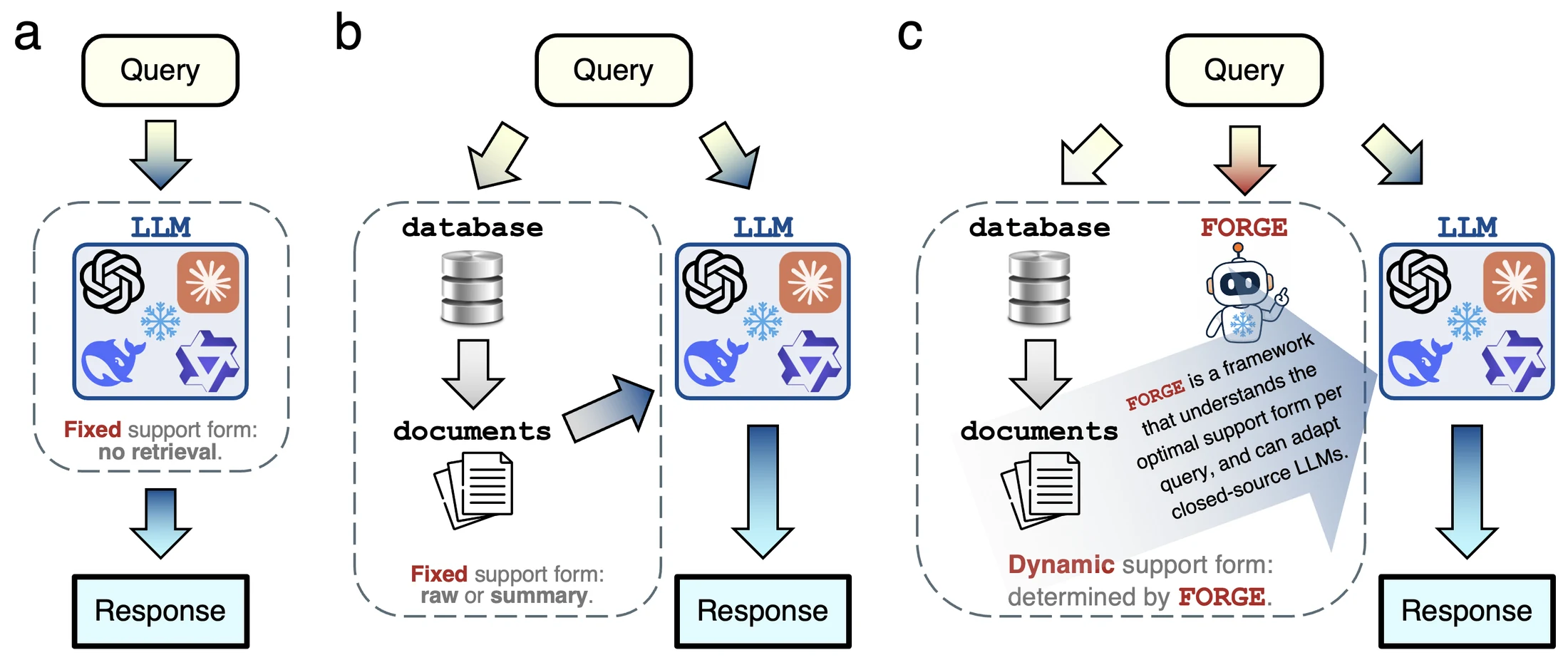
Evidence form is a control variable.
Raw passages, summaries, tables, key-value facts, and abstention are each optimal for different query conditions.
FORGE learns when a frozen language agent should read raw documents, summaries, tables, key-value facts, or no external evidence at all, reducing cost while improving grounded reasoning.
Abstract
Retrieval-augmented language agents often rely on fixed evidence formats, such as always passing raw documents or always passing summaries, even though different queries benefit from different forms and reasoning budgets.
FORGE is a compact factorized router that learns form-optimal evidence routing for frozen language agents. It enumerates candidate evidence forms, distills routing behavior, and refines decisions with reinforcement learning, improving accuracy while reducing token cost across benchmarks and backbones.
Three claims
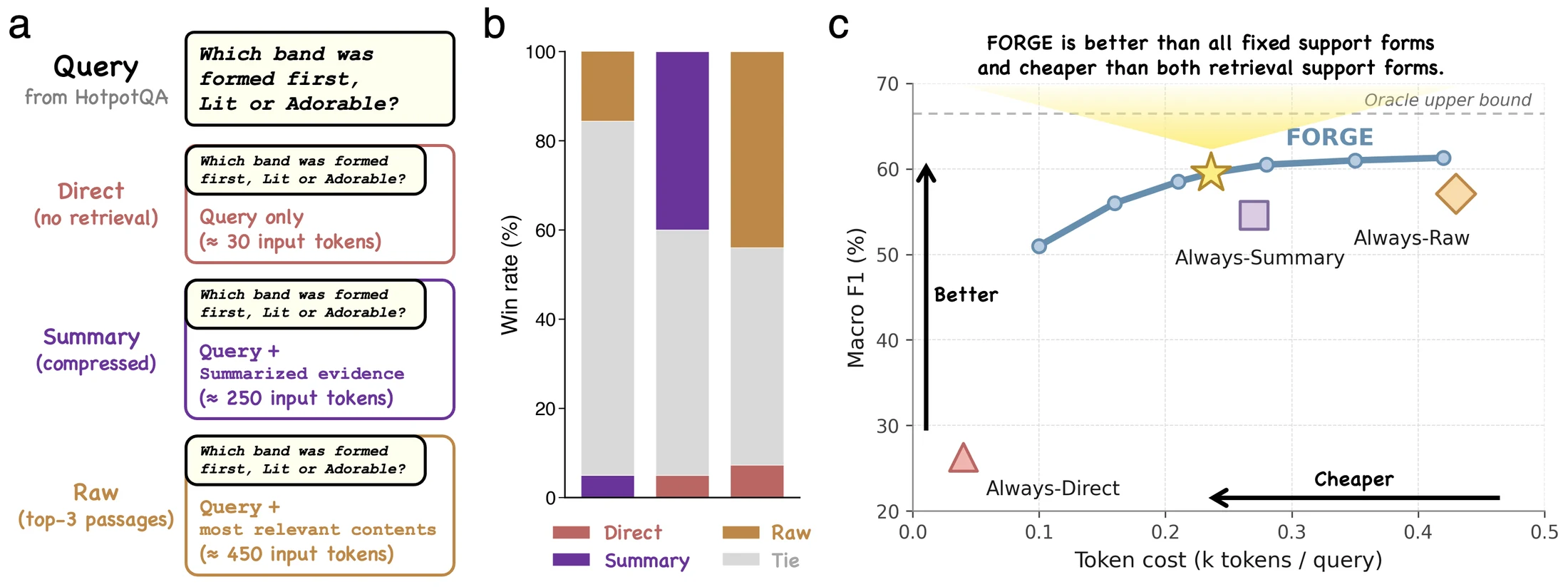
Raw passages, summaries, tables, key-value facts, and abstention are each optimal for different query conditions.
A 269K-parameter factorized router makes per-query decisions without modifying the frozen language agent.
FORGE routes away from expensive default context when cheaper evidence forms are sufficient, while preserving or improving grounded performance.
Method
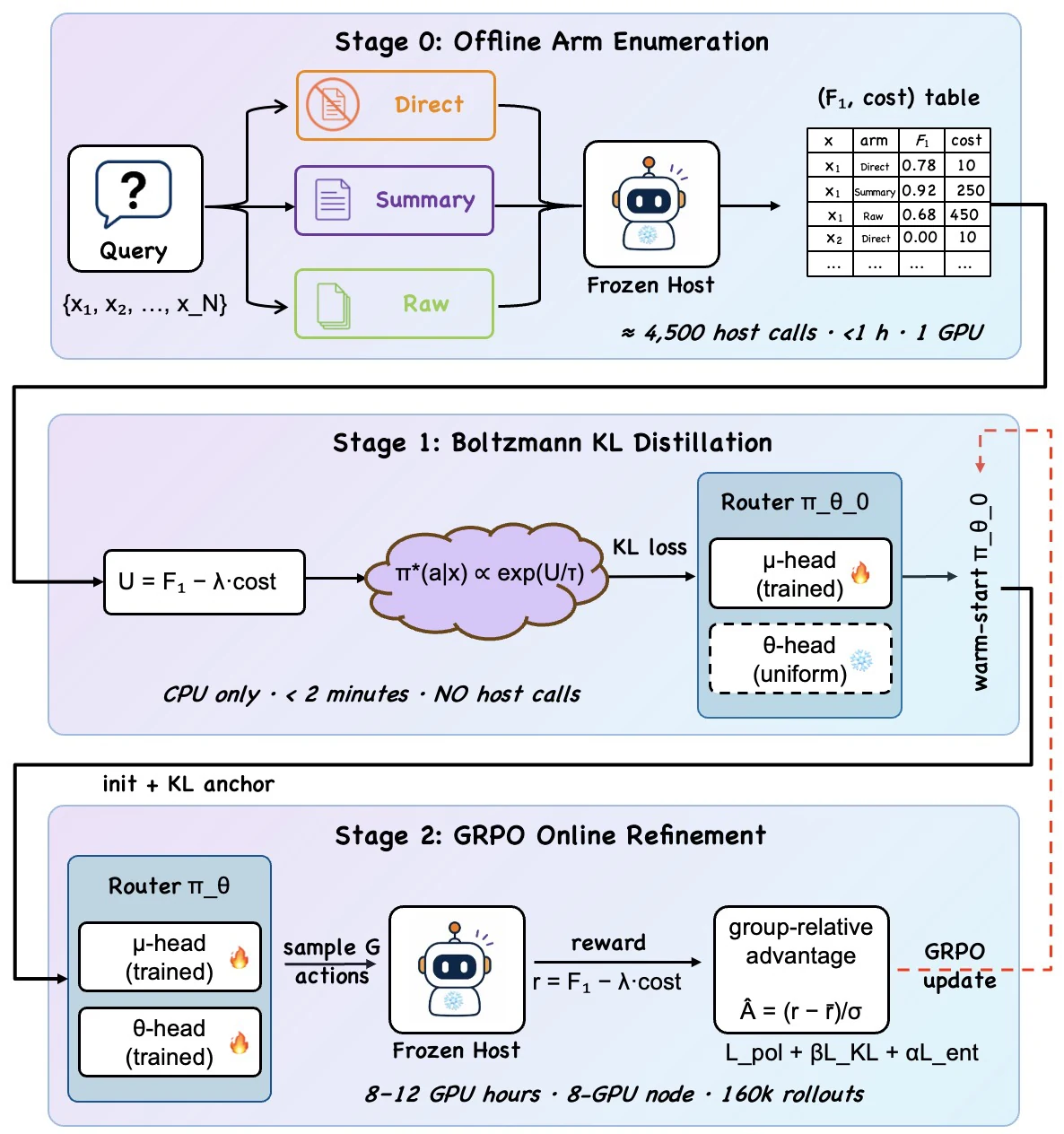
Candidate evidence forms and budgets are evaluated to reveal which route works best for each training query.
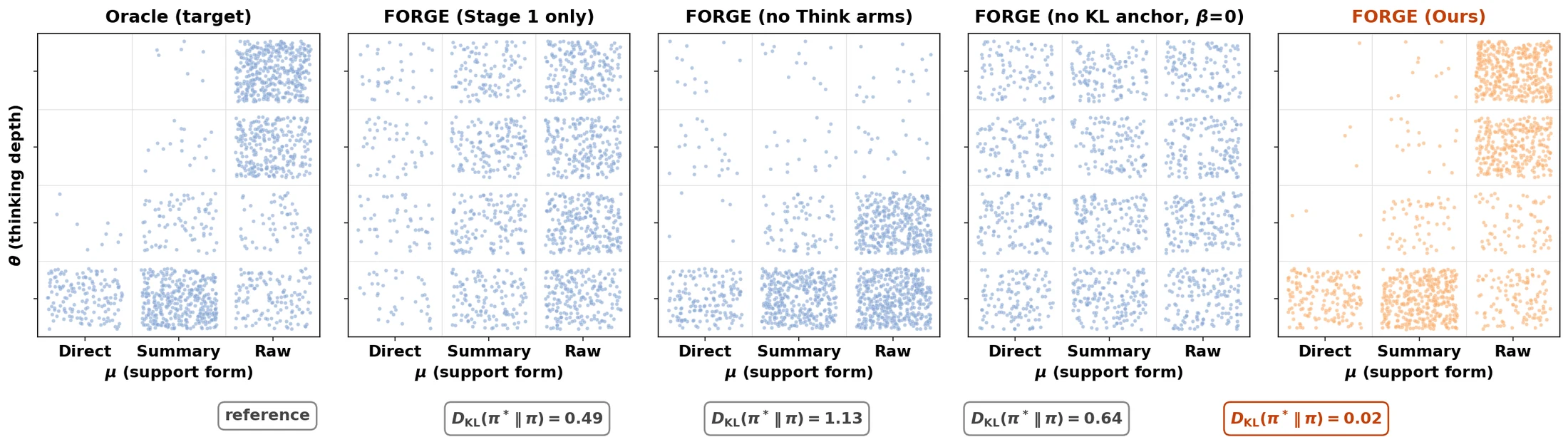
A compact router learns the enumerated oracle behavior through KL-style policy distillation.
GRPO-style optimization adjusts the router toward the downstream reward and token-cost tradeoff.
Routing Decision
route(query) = evidence form + reasoning budget for the frozen agent
Results
Why it matters
Long context is not automatically better grounding. It can add cost, distract the model, and obscure the compact evidence needed for a specific question.
FORGE treats evidence representation as a learned decision, making frozen agents more practical for settings where accuracy, latency, and token cost all matter.
Citation
If our work is helpful to your research, please consider citing FORGE. Thank you.
@misc{xiao2026forge,
  title        = {FORGE: Form-Optimal Routing of Grounded Evidence for Frozen Language Agents},
  author       = {Xi Xiao and Yunbei Zhang and Chen Liu and Lin Zhao and Jialin Chen and Tianchen Zhao and Xiang Xu and Smita Krishnaswamy and Tianyang Wang and Min Xu},
  year         = {2026},
  note         = {Project page: https://xixiaouab.github.io/FORGE/}
}