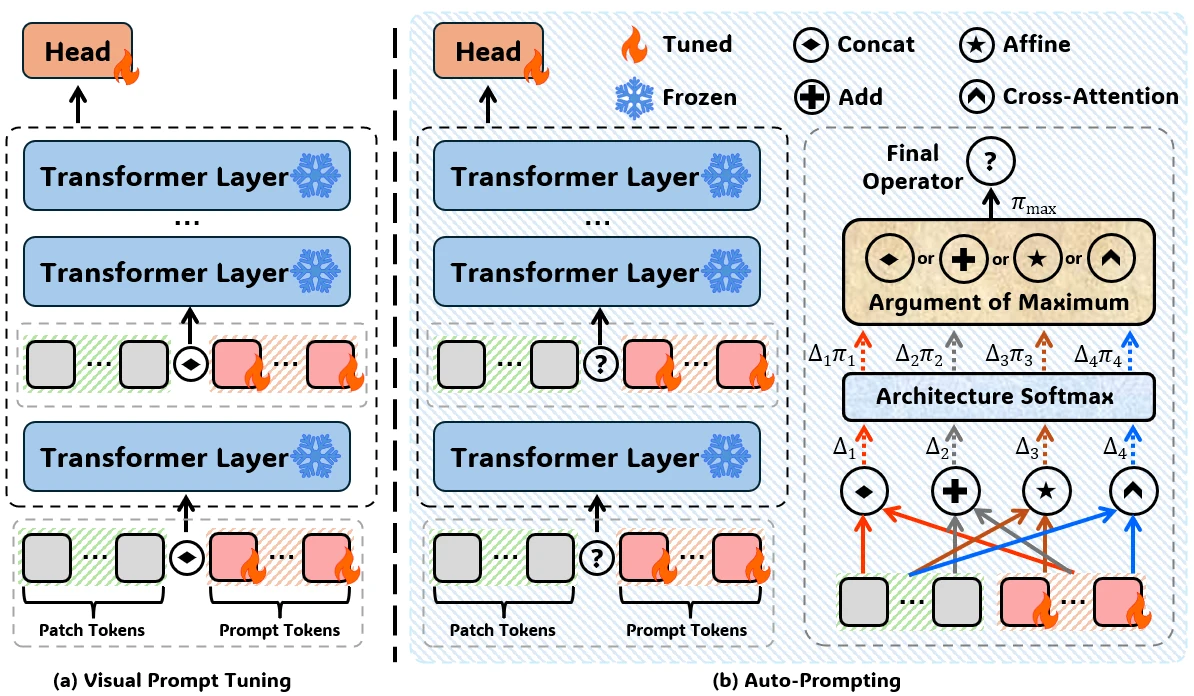
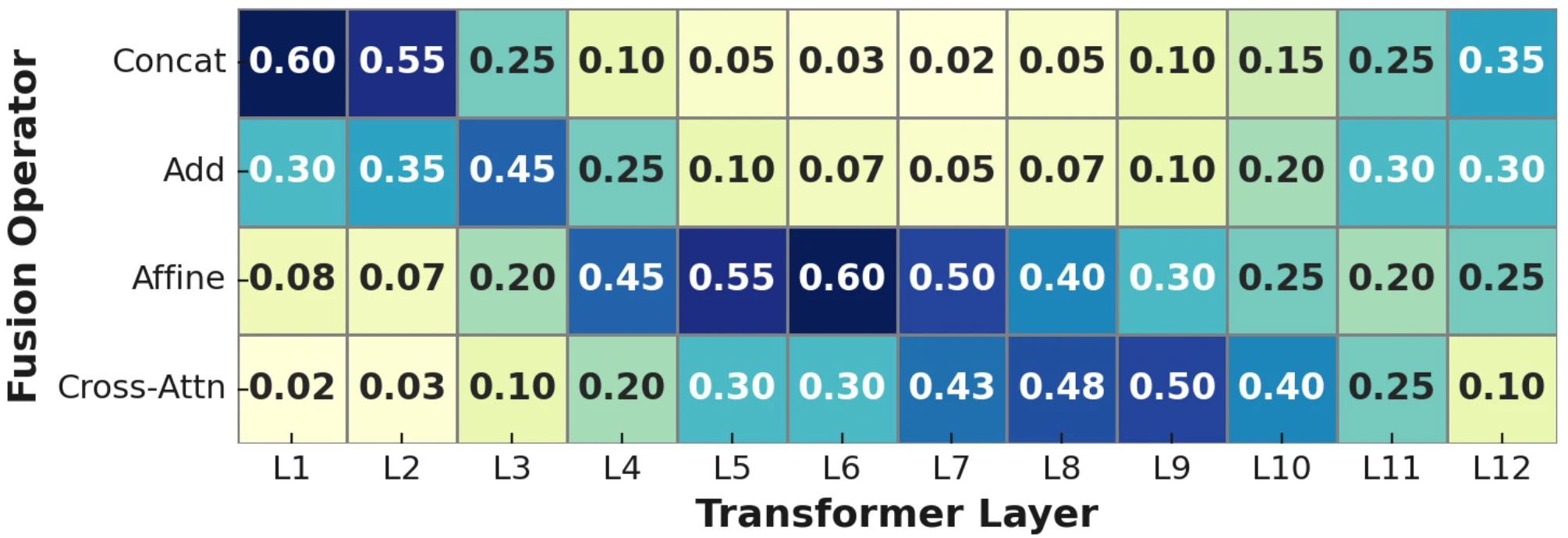
Fusion is layer dependent.
Early, middle, and late transformer blocks benefit from different prompt-token interactions.
A differentiable search framework discovers which prompt-token fusion operator each transformer layer should use, replacing one-size-fits-all visual prompt injection.
ECCV 2026
Abstract
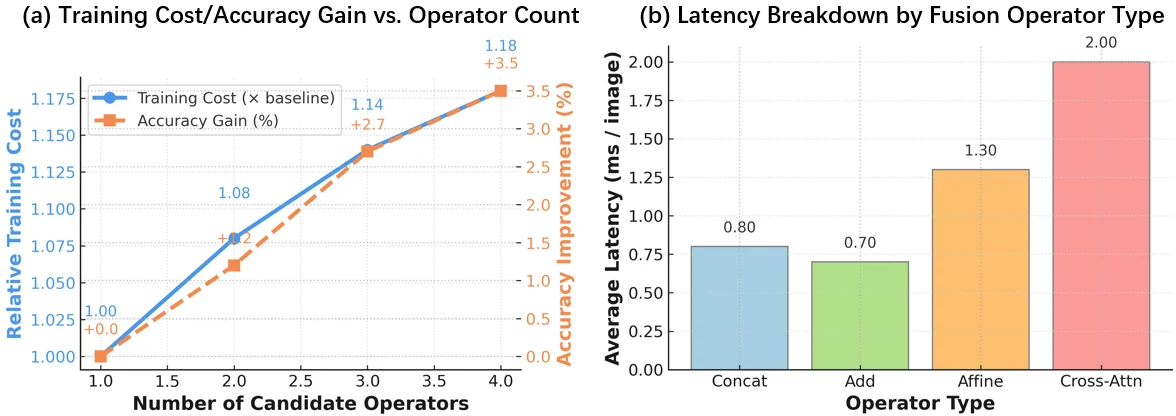
Visual prompt tuning has emerged as a parameter-efficient fine-tuning approach for adapting large-scale Vision Transformers (ViTs) to downstream tasks. As its learnable prompts are applied in input and feature spaces, prior to jointly going through attention in transformer layers, the most commonly used scheme for fusing image and prompt tokens is concatenation or addition. In this paper, we aim to study a fundamental yet essential problem in visual prompt tuning: whether a single fusion scheme tends to yield better results, and whether that would be beneficial to develop a hybrid fusion scheme. To this end, we formulate the task as a bi-level optimization problem, and solve it leveraging differentiable architecture search. In this context, the learnable prompts and their fusion schemes are jointly optimized. To enrich the search space in the architecture search, we propose two additional fusion schemes, namely, affine transformation and cross-attention, in addition to concatenation and addition. Extensive experiments on 34 datasets spanning VTAB-1k, FGVC, and HTA show consistent gains over prompt-tuning baselines. With a frozen ViT backbone, our method delivers a favorable accuracy--latency--parameter trade-off compared with VPT-Deep and recent variants. Our findings reveal that how prompts fuse with image tokens plays a significant role in visual prompt tuning, and a hybrid fusion fashion can more effectively leverage layer semantics of ViTs, contributing a novel perspective for visual prompt-tuning research.
Author preprint PDF · Full-text HTML on arXiv
Xi Xiao et al. · arXiv:2606.26379v1 (2026/06/24). This unchanged author preprint is shared under CC BY 4.0.
Three claims
Early, middle, and late transformer blocks benefit from different prompt-token interactions.
Differentiable selection finds hybrid fusion paths that outperform the best single fixed operator.
The searched design reaches strong transfer performance while tuning roughly 0.75% of model parameters.
Method
Each layer can choose among concatenation, addition, affine fusion, and cross-attention-style prompt interactions.
Architecture weights and prompt parameters are optimized on separate splits to discover robust fusion policies.
The final layer-wise policy is discretized, then trained as an efficient prompt module on top of the frozen backbone.
Fusion Search
argmin over layer-wise fusion choices: validation loss after prompt training
Results
Why it matters
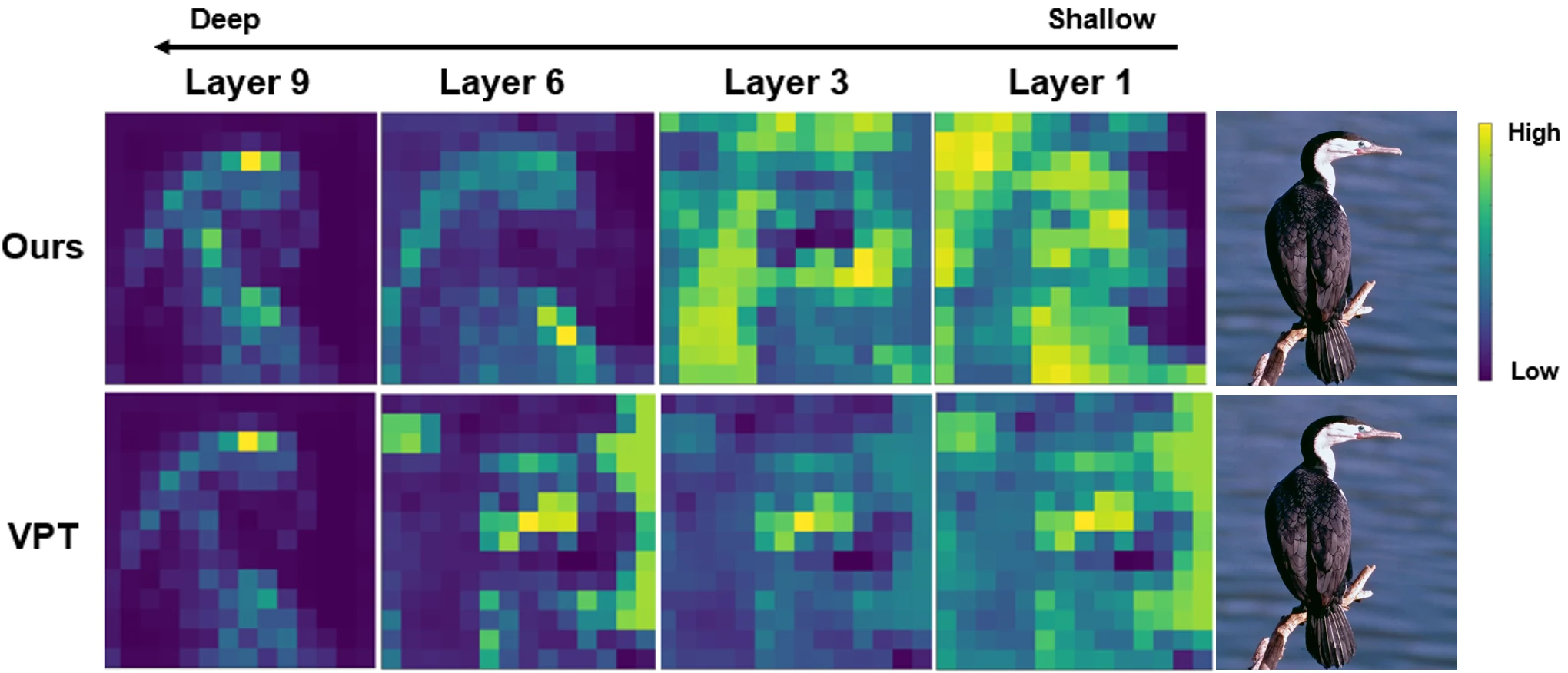
Frozen vision transformers are not homogeneous stacks; their layers specialize. A single prompt fusion rule therefore constrains adaptation in a way that is easy to overlook.
Layer-specific discovery gives parameter-efficient tuning a principled route to match fusion behavior with representation depth.
Citation
If our work is helpful to your research, please consider citing this paper. Thank you.
@misc{xiao2026promptfusiondiscovery,
  title        = {Layer-Specific Prompt Fusion Discovery via Differentiable Search in Vision Foundation Models},
  author       = {Xi Xiao and Xingjian Li and Yunbei Zhang and Cheng Han and Tianming Liu and Tianyang Wang and Runmin Jiang and Jihun Hamm and Xiao Wang and Min Xu},
  year         = {2026},
  note         = {Project page: https://xixiaouab.github.io/Prompt-Fusion-Discovery/}
}