Abstract
Key Results at a Glance
(LLaMA-7B)
(LLaVA-1.5-7B)
(RoBERTa-base)
(training-only modules)
Method Overview
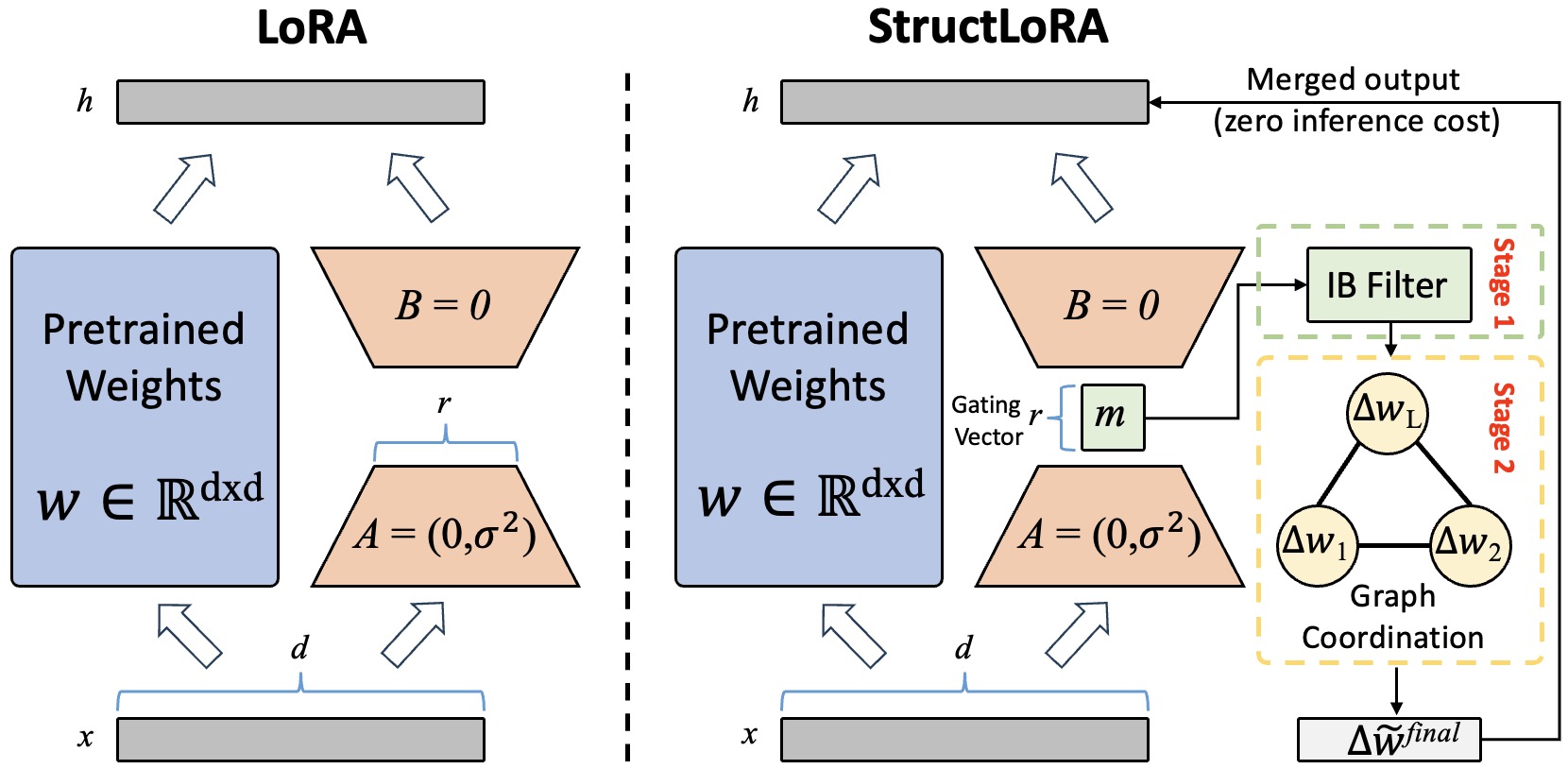
We identify two fundamental, unaddressed shortcomings in the LoRA paradigm. Semantic drift stems from allocating a limited parameter budget uniformly across all low-rank update directions, assuming each direction is equally important. Structural incoherence arises from adapting each layer independently, disregarding the compositional structure of deep Transformers.
Information Bottleneck-Guided Directional Filtering
LoRA spreads a small budget over $r$ directions and treats them the same. In practice, only a few directions help predict the label; others carry nuisance variation. We gate the $r$ rank-one directions with a learnable mask $\mathbf{m} \in [0,1]^r$ and form the filtered update:
$\Delta \tilde{W} = A\,\text{diag}(\mathbf{m})\,B$
We learn $\mathbf{m}$ by an Information Bottleneck objective that rewards dependence on labels while penalizing spurious dependence on inputs, effectively raising the signal-to-noise ratio of the update.
Graph-Based Layer Coordination
We view the network as a graph $\mathcal{G}=(\mathcal{V},\mathcal{E})$ with one node per layer, where the node feature is the flattened filtered update. We connect adjacent layers and add semantic edges between layers with highly aligned gradients.
A shallow GNN with residual connections propagates and refines the filtered updates, encouraging smoother adaptation trajectories across the model's depth. Both modules are discarded at inference, so latency stays identical to vanilla LoRA.
Main Results
Table 1. Main comparison across language, vision, and multimodal benchmarks (~0.5–1% trainable parameters).
| Method | Type | BoolQ | PIQA | CIFAR-100 | ImageNet-1k | COCO Cap. | VQAv2 |
|---|---|---|---|---|---|---|---|
| Full Fine-tuning | — | 82.6 | 85.3 | 85.9 | 78.8 | 123.5 | 76.2 |
| LoRA | Reparam. | 79.1 | 82.4 | 81.5 | 76.2 | 116.2 | 73.5 |
| QLoRA | Reparam. | 80.0 | 83.1 | 82.7 | 76.9 | 119.1 | 74.2 |
| DoRA | Reparam. | 80.6 | 83.7 | 83.2 | 77.3 | 120.3 | 75.0 |
| Sensitivity-LoRA | Dynamic Rank | 80.9 | 84.0 | 83.5 | 77.5 | 120.8 | 75.2 |
| LoRA-Dropout | Sparsity | 80.2 | 83.3 | 82.5 | 76.8 | 118.8 | 74.5 |
| StructLoRA (Ours) | Filter + Coord. | 82.1 | 84.9 | 85.1 | 78.6 | 122.9 | 75.9 |
Table 2. Head-to-head comparison on the GLUE benchmark (RoBERTa-base).
| Method | MNLI | SST-2 | MRPC | CoLA | QNLI | QQP | RTE | STS-B | Avg. |
|---|---|---|---|---|---|---|---|---|---|
| LoRA | 87.3 | 93.5 | 87.1 | 58.8 | 93.0 | 90.5 | 79.4 | 91.0 | 85.1 |
| AdaLoRA | 87.3 | 93.6 | 87.3 | 59.0 | 93.1 | 90.6 | 79.6 | 91.2 | 85.2 |
| Sensitivity-LoRA | 87.6 | 94.6 | 87.7 | 60.2 | 93.6 | 90.7 | 81.8 | 91.3 | 86.0 |
| StructLoRA (Ours) | 88.1 | 95.0 | 88.5 | 61.5 | 94.1 | 91.0 | 82.3 | 91.5 | 86.5 |
Performance in Challenging Regimes
StructLoRA shines brightest where it matters most — under low-rank and low-data conditions.
Table 3. Performance under varying rank budgets.
| Rank ($r$) | Params (%) | BoolQ (LLaMA-7B) | CIFAR-100 (ViT-B/16) | COCO Caption (LLaVA) | |||
|---|---|---|---|---|---|---|---|
| LoRA | StructLoRA | LoRA | StructLoRA | LoRA | StructLoRA | ||
| 2 | 0.12 | 75.1 | 77.4 (+2.3) | 78.3 | 80.1 (+1.8) | 111.2 | 114.3 (+3.1) |
| 4 | 0.24 | 77.6 | 79.9 (+2.3) | 79.7 | 82.2 (+2.5) | 113.8 | 117.0 (+3.2) |
| 8 | 0.48 | 79.1 | 81.3 (+2.2) | 81.5 | 84.1 (+2.6) | 116.2 | 122.4 (+6.2) |
| 16 | 0.95 | 80.3 | 81.7 (+1.4) | 82.8 | 84.3 (+1.5) | 118.1 | 123.6 (+5.5) |
| 32 | 1.90 | 81.0 | 81.9 (+0.9) | 83.4 | 84.5 (+1.1) | 119.0 | 123.9 (+4.9) |
Table 4. Performance under limited supervision (few-shot learning), rank $r=8$.
| Dataset | Method | 10% | 25% | 50% | 100% |
|---|---|---|---|---|---|
| BoolQ (LLaMA-7B) | LoRA | 68.5 | 73.2 | 76.4 | 79.1 |
| StructLoRA | 71.2 (+2.7) | 76.3 (+3.1) | 78.9 (+2.5) | 81.3 (+2.2) | |
| CIFAR-100 (ViT-B/16) | LoRA | 73.6 | 78.0 | 80.5 | 81.5 |
| StructLoRA | 76.3 (+2.7) | 80.5 (+2.5) | 82.4 (+1.9) | 84.1 (+2.6) | |
| COCO Caption (LLaVA) | LoRA | 100.2 | 108.3 | 114.0 | 116.2 |
| StructLoRA | 103.7 (+3.5) | 112.4 (+4.1) | 117.9 (+3.9) | 122.4 (+6.2) |
Ablation Studies
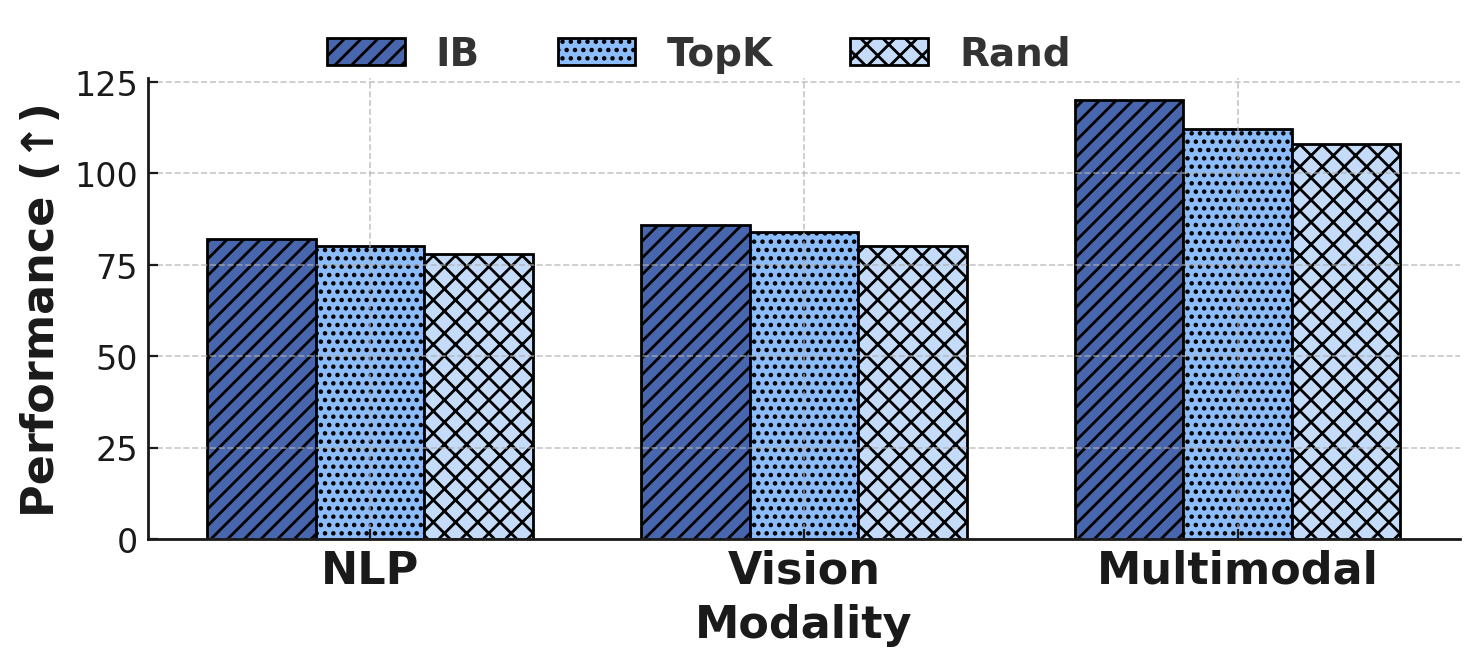
Both the IB filter and the GNN coordinator are essential. Removing either degrades performance, and removing both collapses StructLoRA back to standard LoRA.
Table 5. Module-wise ablation of StructLoRA.
| Setting | BoolQ | $\Delta$ | CIFAR-100 | $\Delta$ | COCO Cap. | $\Delta$ |
|---|---|---|---|---|---|---|
| StructLoRA (Full) | 81.3 | — | 84.1 | — | 122.4 | — |
| w/o IB Filter | 79.4 | -1.9 | 81.9 | -2.2 | 117.8 | -4.6 |
| w/o GNN Coordination | 80.1 | -1.2 | 82.6 | -1.5 | 119.4 | -3.0 |
| w/o Both (= LoRA) | 79.1 | -2.2 | 81.5 | -2.6 | 116.2 | -6.2 |
Visualizing Structural Coherence
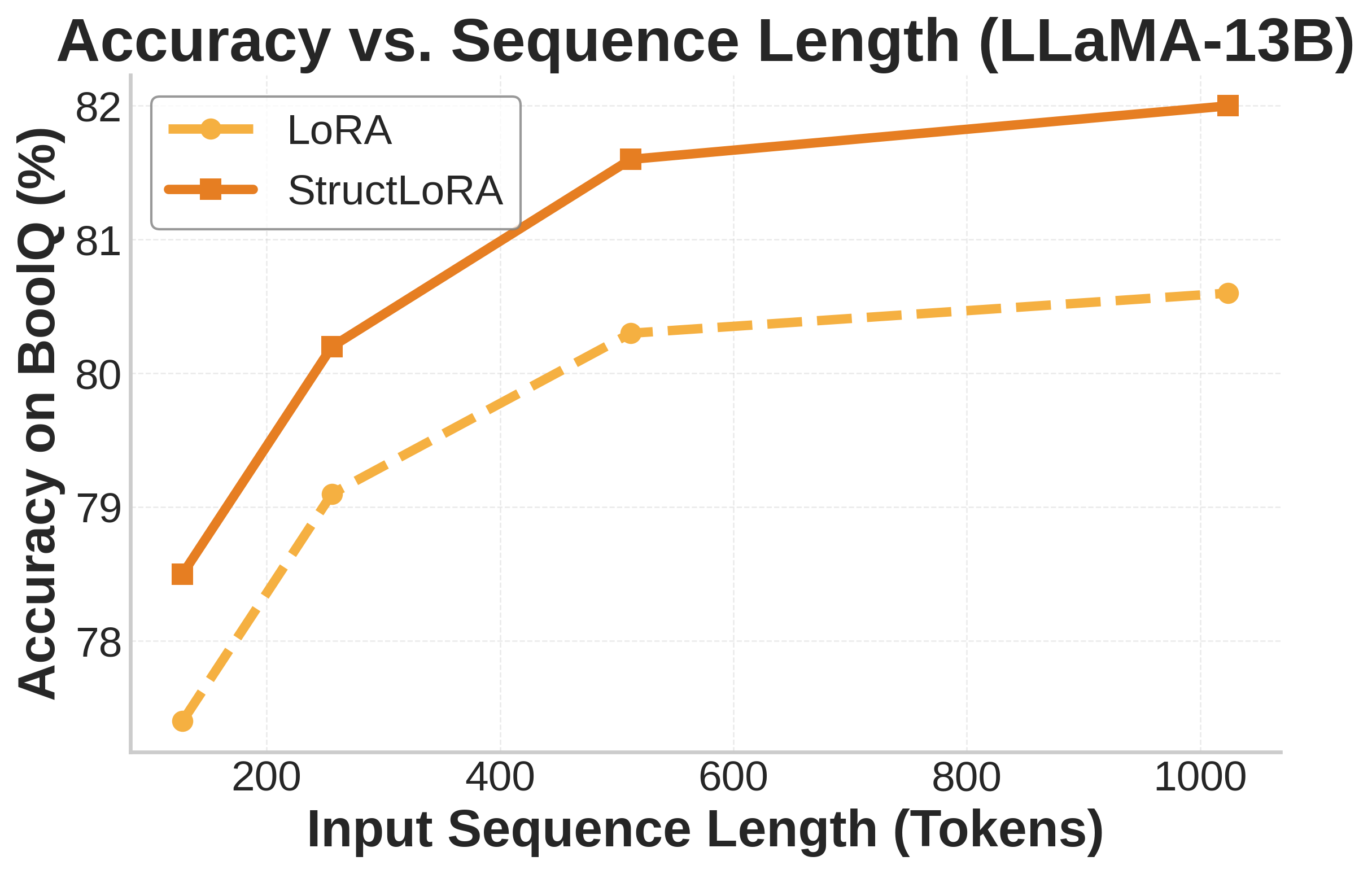
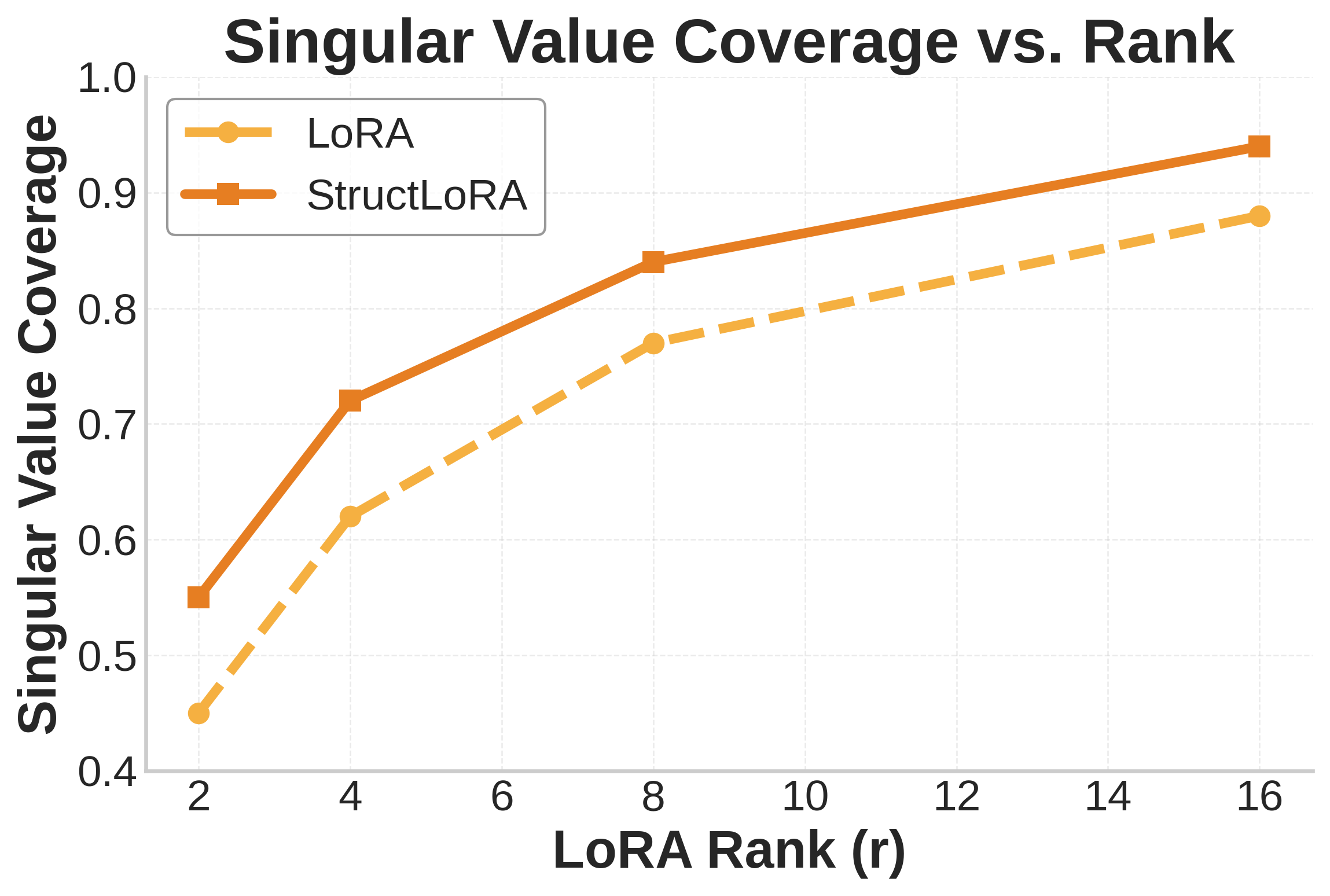
BibTeX
If you find our work useful, please consider citing: